


The Real Problem with Video Production Was Never Creativity
Many companies have powerful stories, valuable products, and authentic expertise, yet traditional video production has long made it difficult to turn them into communication. AI lowers the barriers; method still makes the difference.
The problem was never finding something worth telling.
Many companies already possess everything needed to support effective communication: an authentic story, valuable products, a real identity, and expertise built over time. Yet this heritage often remains invisible.
Not because ideas are missing. Not because value is missing. But because, for years, turning those ideas into professional video content required economic, organizational, and technical conditions that were difficult to sustain.
The ideas were already there
A small company may have a unique production process. A territory may preserve a story capable of moving people. A product may represent years of research, craftsmanship, and vision. All of this is narrative material.
The critical point has always been the transition from material to story: how can expertise, processes, and values be transformed into images that capture attention and leave a lasting impression?
When that transition becomes too complex or expensive, communication is postponed, reduced to occasional content, or entrusted to solutions that fail to express the company’s real value.
Why professional video production was so difficult
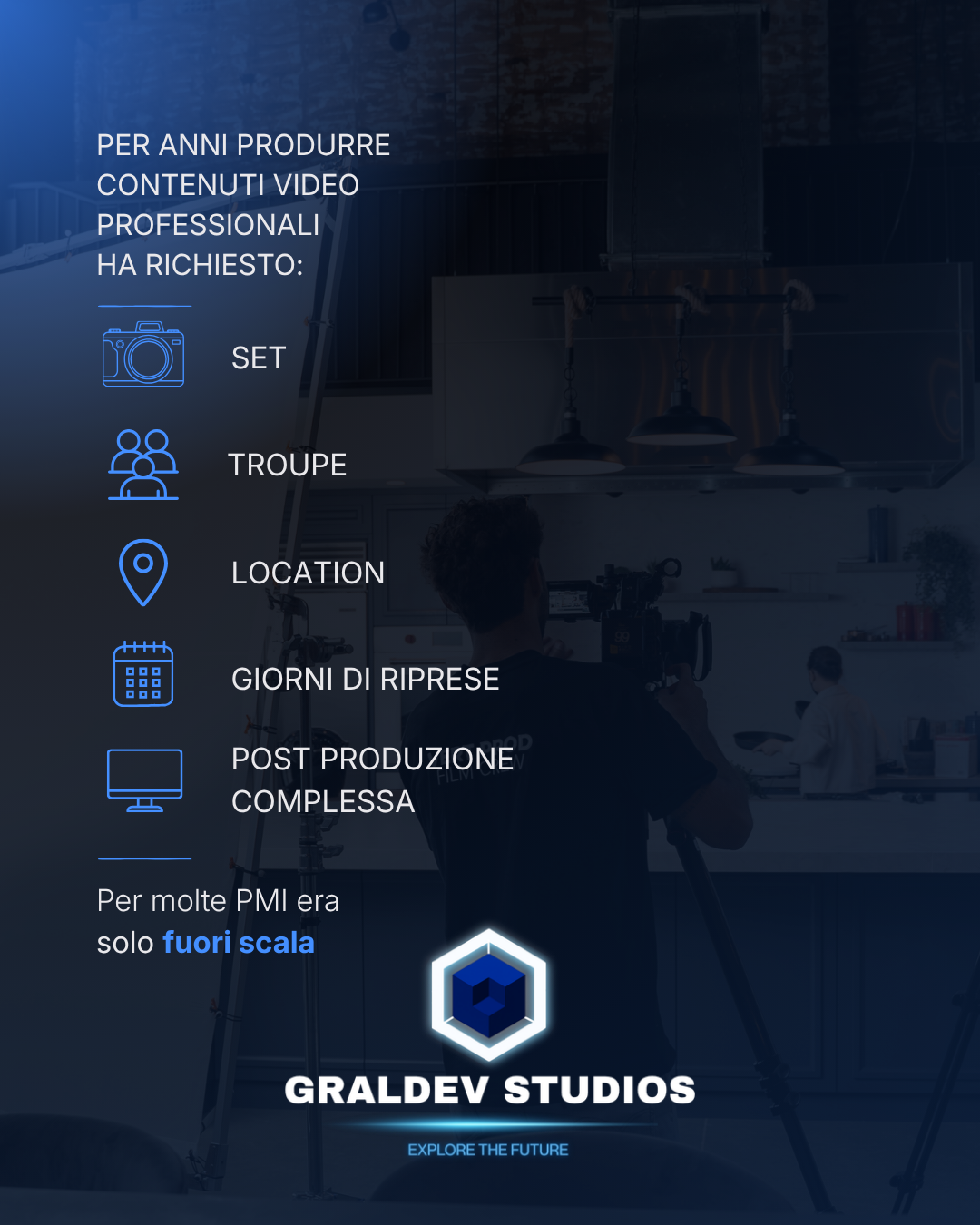
For a long time, creating high-level content meant coordinating many different elements:
- a suitable set;
- a crew with multiple specialist skills;
- locations, permits, and travel;
- shooting days compatible with people, products, and spaces;
- a long and complex post-production stage.
The cost was not only financial. It was organizational as well. Every change could require new shooting, new schedules, and renewed coordination. For many SMEs, professionals, and local organizations, quality video therefore felt valuable but out of scale.
The invisible cost of giving up
When a company gives up on telling its story, it does not simply lose a video. It loses opportunities to be understood, recognized, and remembered.
A product remains confined to its technical features. A company story stays locked in an archive. Expertise that is difficult to explain fails to become perceived value. Meanwhile, less substantial but more communicative competitors occupy attention.
A lack of content does not make a company less valuable. It makes the company harder to see.
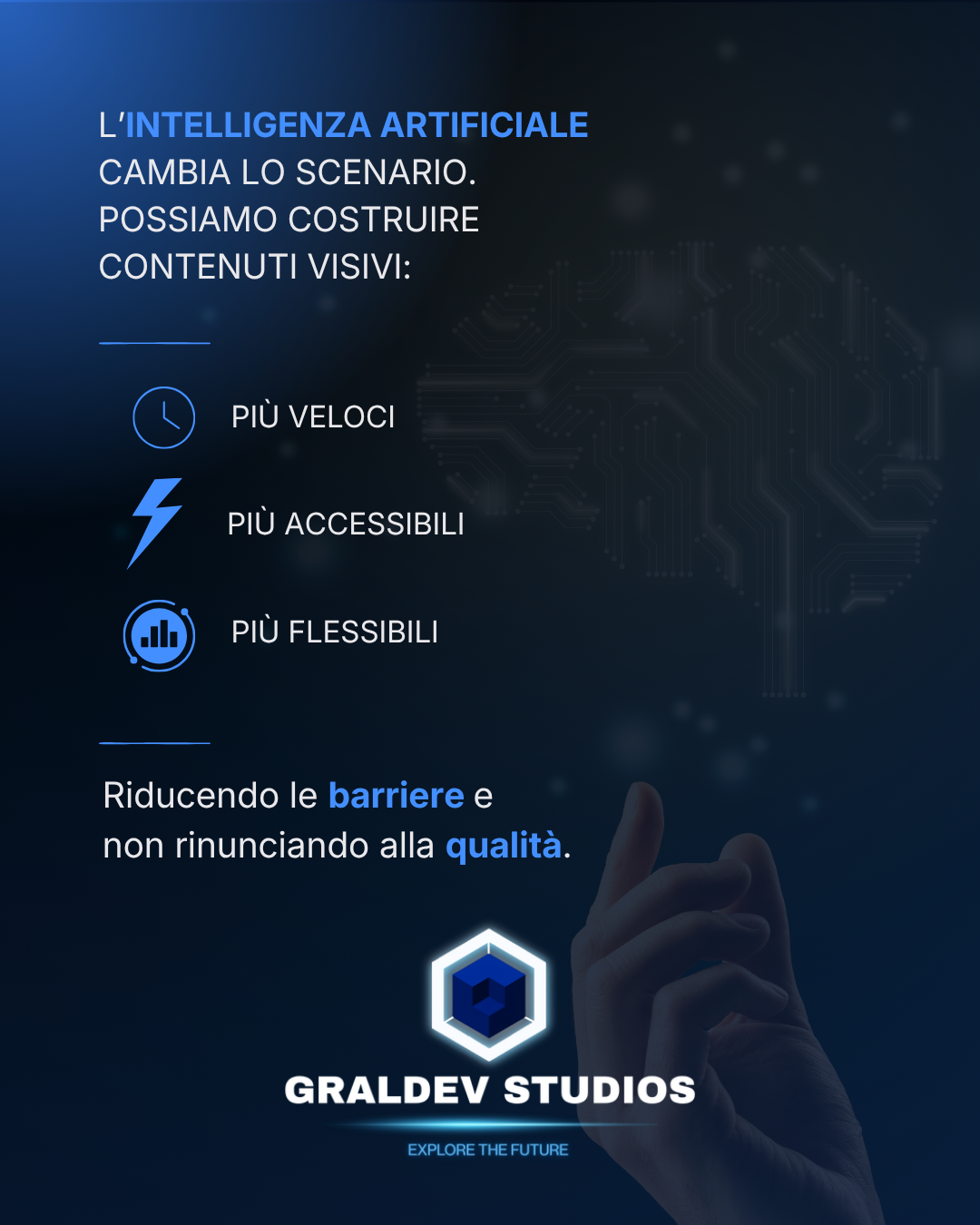
Artificial intelligence changes the landscape
AI-driven video production makes it possible to build scenes, environments, and camera movements from images, concepts, storyboards, and existing materials.
This does not mean that every production should eliminate traditional filming. It means being able to choose a different process when sets, locations, or logistics are not the most efficient solution.
The three clearest benefits are:
- Greater speed: concepts and variations can be developed and tested more quickly.
- Greater accessibility: visually ambitious productions become possible with more contained budgets.
- Greater flexibility: scenes, formats, and adaptations can be designed for different channels.
Lowering barriers, however, does not mean lowering standards. It means using new tools to invest more energy in what truly matters: the message.
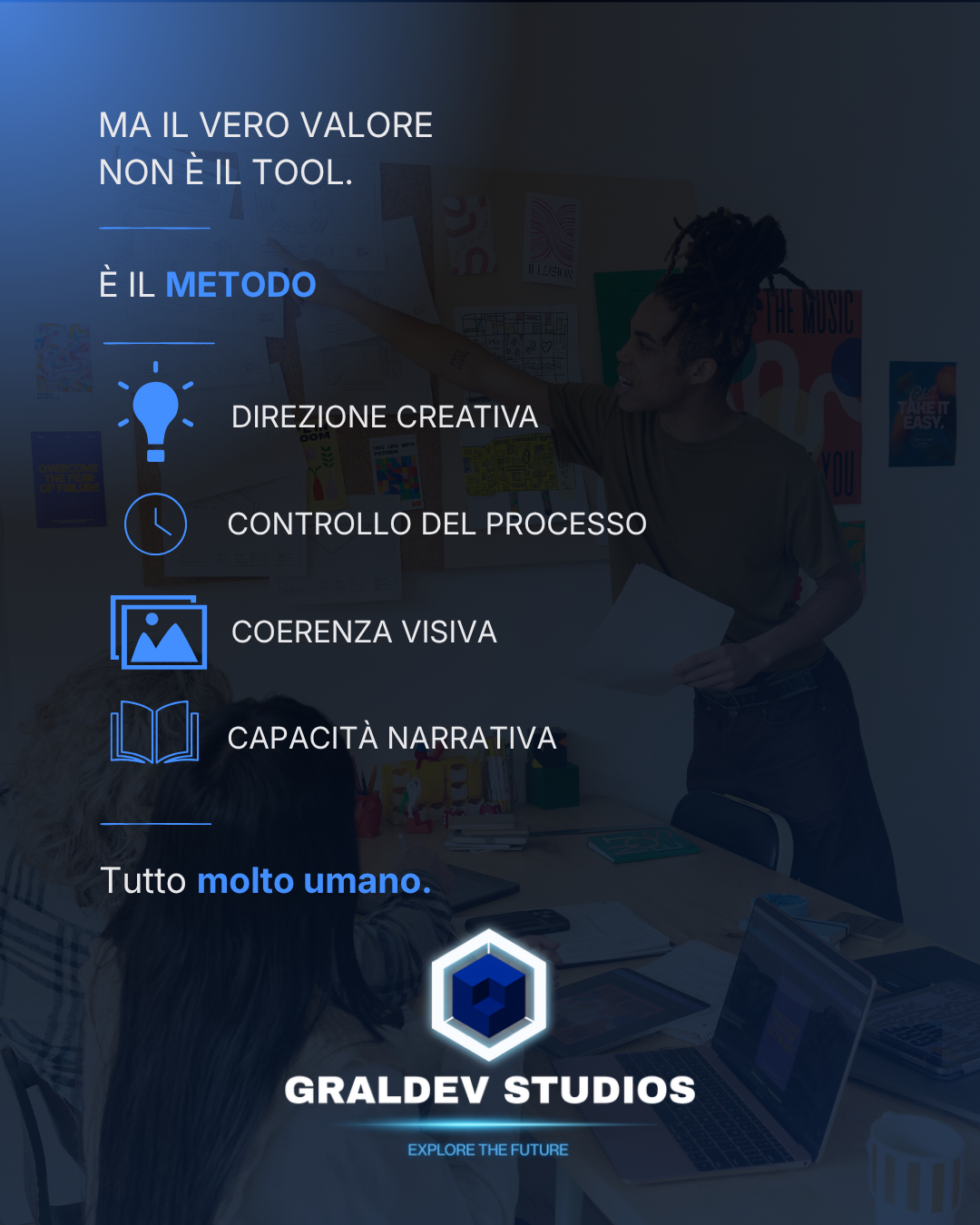
The real value is not the tool
A generative model can produce a technically striking image. It cannot independently decide which part of a company’s story deserves to become the center of the narrative. It does not determine which tone fits the brand, which emotion should remain, or which details could make the content feel generic.
Turning generation into communication requires deeply human skills:
- Creative direction: defining the idea, atmosphere, and point of view.
- Process control: selecting, correcting, and iterating without losing the objective.
- Visual consistency: keeping style, subjects, palette, and visual language recognizable.
- Narrative ability: building a journey with rhythm, meaning, and a conclusion.
AI expands the possibilities. Method decides which possibilities deserve to become content.
An AI-driven process is not a prompt
An effective production does not begin with a sentence entered into a generator. It begins with a structured path:
- Analysis: understand the brand, audience, and purpose of the video.
- Concept: identify the idea that can make the message distinctive.
- Storyboard: organize scenes, framing, rhythm, and transitions.
- Visual system: define references, palette, light, environments, and subject continuity.
- Controlled generation: produce and select sequences through targeted iterations.
- Editing and finishing: combine video, sound, text, and color grading into a unified result.
This structure is what prevents the content from feeling like a collection of spectacular but disconnected images.
More accessible does not mean automatic
The democratization of tools is a major opportunity, but it also creates a misunderstanding: assuming that because production is more accessible, quality has become automatic.
In reality, when everyone can generate images, selection, consistency, and identity become even more important. The advantage does not belong to those who produce the most material, but to those who can turn it into precise communication.
A new way of producing begins here
Graldev Studios was founded on the idea that professional video production can become more agile without losing direction, depth, or identity.
Our approach combines technical expertise, cinematic sensitivity, and communication strategy. We begin with what the company already has — products, imagery, history, values, and existing materials — and turn it into content capable of telling that story in a new way.
Creativity was never missing. Now there are different conditions for turning it into images.
Want to tell your brand story?
Discover how we produce cinematic AI-driven videos and immersive experiences without physical production sets.